

5 minute read
Breaking product management into three focused roles—strategy, technology, and marketing—can clarify responsibilities and improve collaboration. Read about this approach and how it works.
Product manager roles are notoriously confusing, especially when you compare them from organization to organization, and it’s easy to see why. It’s no easy task to organize product management when there are multiple people of varying skill sets involved in the process. How many product managers do you need and what are they responsible for? Is product management a support role or a strategic one? How do you use various product management titles such as product manager, product marketing manager, program manager, or product owner?
Product management titles are also poorly understood and defined differently by many organizations. Every year, participants in Pragmatic Institute’s Annual Product Management and Marketing Survey identify hundreds of different titles for those conducting product management activities. How can you clarify the landscape? An ideal solution for many companies is the “product management triad.”
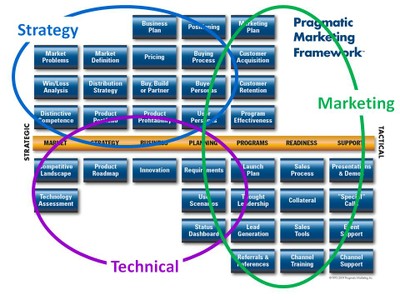
Some product managers have a natural affinity for working with Development, others for Sales and Marketing, and some prefer to work on business issues. Finding these three orientations in one person is very difficult. Instead, perhaps we should find three different people who each possess one or more of these skills, and have them work as a team.
The product management triad includes a strategist, a technologist, and a marketer. It includes a business-oriented senior product manager that is responsible for product strategy. This person becomes the director of products or product line manager (PLM). Now add a technology-oriented technical product manager (TPM) and a marketing oriented product marketing manager (PMM) to round out your triad.
Product Management Triad in Action
Consider a scenario where a company with nine product managers, each overseeing a different product, sought to enhance collaboration and efficiency across their teams. Initially, the dynamic between salespeople and product managers was uneven—some product managers were favored by the sales team, while others faced challenges in gaining their support. This disparity also extended to the relationship with developers, where preferences were equally divided.
To address these challenges, the company implemented a product management triad structure. They reorganized into three distinct product lines, each led by a Product Line Manager (PLM). Alongside each PLM, a Technical Product Manager (TPM) and a Product Marketing Manager (PMM) were appointed. This triad approach allowed for a more focused and collaborative effort within each product line.
With this structure, the PLM was able to dedicate their attention to product strategy and the overarching business objectives of the product line. The TPM worked closely with the Development team to ensure the technical aspects of the product were prioritized and executed effectively. Meanwhile, the PMM collaborated with Marketing Communications and the sales team to craft compelling product narratives and drive market engagement.
This strategic realignment allowed each product line to benefit from specialized roles that aligned with their unique needs, fostering a more harmonious and productive working environment across the company
Product Management Triad Warning
Some companies attempt to put these three people in three different departments. They put the Product Line Manager into Sales to do business development, the Technical Product Manager in Development, and the Product Marketing Manager in Marketing Communications. This always fails. To work as a team, they must actually be a team.
Having the TPM and PMM report to the same person, the PLM, minimizes conflict and overlap, giving the team a common objective. It has the added benefit of giving a new director the chance to learn to be a good manager of two people before getting five or ten people to manage.
Product Management Team Career Paths
Product management teams provide career paths from entry-level positions to director, all within the product line.
Execution vs. ownership
As shown in the graphic, these three product positions overlap. This is deliberate. Execution of these tasks must be collaborative in order to succeed. For example, win/loss analysis is an excellent data source for positioning and the buying process. Your Product Line Manager and Product Marketing Manager ought to perform win/loss visits together to ensure you gain the most value.
But do not confuse execution with ownership. Ownership of a task equates to accountability. For example, as the executive leader of a team structured this way, the Product Line Manager is held accountable for win/loss analysis even if their team members are the ones that gather the win/loss data.
First Triad Tier: Director, Product Strategy
The director of product strategy has a business-orientation and is responsible for the development and implementation of the strategic plan for a specific product family. They maintain close relationships with the market (customers, evaluators, and potentials) for awareness of market needs. This includes identification of appropriate markets and development of effective marketing strategies and tactics for reaching them. This person is involved through all stages of a product family’s lifecycle.
The director of product strategy must:
- Discover and validate market problems (both existing and future customers)
- Seek new market opportunities by leveraging the company’s distinctive competence
- Define and size market segments
- Conduct win/loss analysis
- Determine the optimum distribution strategy
- Provide oversight of strategy, technical, and marketing aspects of all products in the portfolio
- Analyze product profitability and sales success
- Create and maintain the business plan including pricing
- Determine buy/build/partner decisions
- Position the product for all markets and all buyer types
- Document the typical buying process
- Approve final marketing and go-to-market plans
Second Triad Tier: Technical Product Manager
The technical product manager is responsible for defining market requirements and packaging the features into product releases. This position involves close interaction with development leads, product architects, and key customers. A strong technical background is required. Some typical job duties include gathering requirements from existing and potential customers as well as recent evaluators, writing market requirements documents or Agile product backlogs, and monitoring the implementation of each product project.
The technical product manager must:
- Conduct technology assessments
- Analyze the competitive landscape
- Maintain the product portfolio roadmap
- Monitor and incorporate industry innovations
- Define user personas for individual products
- Write product requirements and use scenarios
- Maintain a status dashboard for all portfolio products
Third Triad Tier: Product Marketing Manager
The product marketing manager provides product line support for program strategy, operational readiness and on-going sales support. This position requires close interaction with Marketing Communications and sales management. Strong communication skills are a must. Duties include converting technical positioning into key market messages and launching new products into market.
The product marketing manager must:
- Define buyer personas and determine market messages
- Create the marketing plan including methods for customer acquisition as well as customer retention
- Measure effectiveness of product marketing programs
- Maintain product launch plans
- Deliver thought-leading content via events, blogs, e-books, and other outlets
- Identify best opportunities for lead generation
- Create standard presentations and demo scripts
- Identify product references for industry and customer referrals
- Align sales tools and the ideal sales process to the typical buying process
- Facilitate channel training including competitive threats and related industry news
How you implement the product management triad depends on your organization and the skills of your team. For example, consider having a role for your base technology or architecture to identify issues that span product lines. The “architecture” product manager can own acquisitions, third-party partnerships, and common tools needed across all product lines.
Start by taking inventory of the skills of each of the product managers. Next, create an organization chart of one triad per product line with no names assigned. Now try to move the business-oriented staff (usually your senior product managers) to the PLM positions, development-oriented product managers to TPM and sales-oriented ones to PMM. The remaining holes in your organization chart represent your new hiring profiles.